
Archive for the 'Low Back Pain' Category

Are you sitting correctly? Our top ten tips for seated posture.

Most of us spend hours sitting: at work, in the car, or in front of a computer- raising the risk of back pain, sciatica and neck problems as a result.  Our daily lifestyle is now much more sedentary and our spine takes much strain from poor posture and sitting positions.  With this in mind here are BOOST PHYSIO’s Top 10 Tips for sitting correctly.

  1. Every 45min of sitting, take a mini-break for 2min and walk around to stop the back muscles from fatiguing.  Prevention is better than cure! This will stop postural fatigue and pain from overloaded ligaments and muscles.
  2. Check your back angle when sitting- see the picture below.
    Chart of pressures in the discs of the lumbar spine

    Disc pressure with different seating positions

  3. Do “The Marble Test” on your car seat to test if your car seat is stressing your back.  Place a marble on the front part of your driver’s seat- if the marble rolls backwards down to the back-rest, your car seat “FAILS”.  If the marble stays where it is your car seat “Passes”.  When the front part of the seat pad of a chair is higher than the back part of the seat pad, this forces the lumbar spine to slouch and compresses the discs.  Use a seating wedge to correct this.
  4. Use a lumbar roll in the small of the back (at waist level) to maintain the lumbar lordosis- this is the natural arch in the small of the back and reduces pressure on the lumbar discs.
  5. Sit tall in your chair with your chin slightly tucked in- this minimizes the “poking chin” posture that so many adopt when in front of a computer screen.

    Are you sitting correctly? BOOST PHYSIO Tyrone Kon giving posture advice.

  6. Square yourself up to the computer keyboard and screen, or the steering wheel of the car.  Do not sit in a twisted position.
  7. Your feet should be flat on the floor with your ankles beneath your knees. This gives a good foundation of support for the lower back and stops stress to the calf muscles.
  8. Your knees should be slightly lower than your hips and your bottom should be to the back of the seat- this enables the optimum back angle of 100 to 110 degrees.
  9. Avoid low, deep sofas as this decreases the back angle and pressure in the spine.
  10. If you are having pain regularly while sitting- come and see us at our Hendon or East Finchley High Street Clinics for postural assessment, advice and treatment.

    BOOST PHYSIO Tyrone Kon giving posture advice

BOOST PHYSIO in Hendon NW4 and East Finchley N2 is a leading physiotherapy clinic specialising in all musculo-skeletal injuries and conditions.  We are open 8am-9pm and on Sundays too!  Call us on 020 8201 7788.

www.boostphysio.com

Like us on Facebook at www.facebook.com/boostphysio

Follow us on Twitter @boostphysio

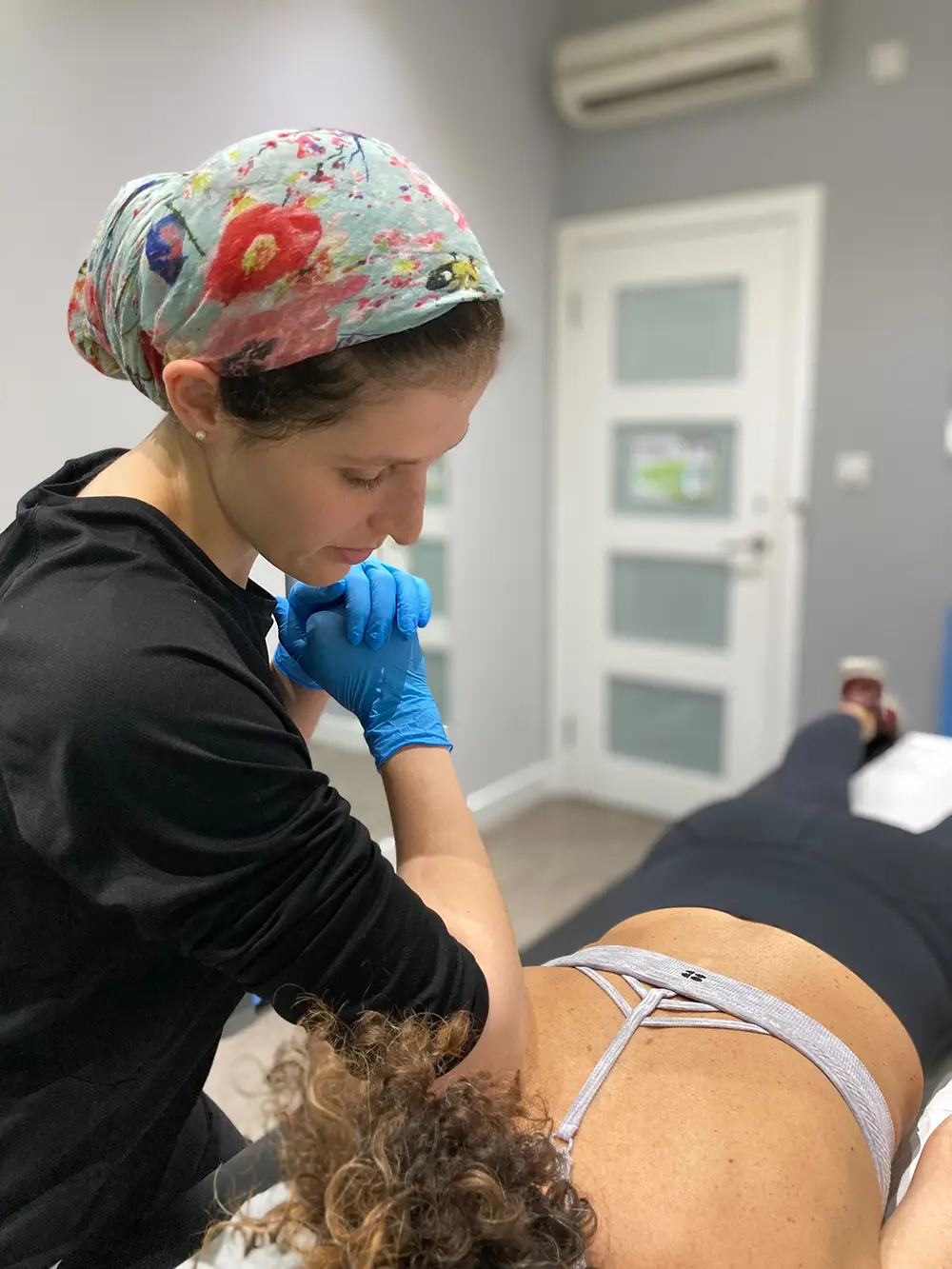
Tyrone Senior BOOST PHYSIO treating back pain

Back Facts from BOOST PHYSIO NW4 and N2

  • Tyrone Senior BOOST PHYSIO treating back pain

    About 80% of the population will experience significant low back pain

  • There are 5 vertebrae in your lower back (lumbar spine), 12 verterbrae in your mid-back (thoracic spine) and 7 vertebrae in your neck (cervical spine)
  • Each verterbra in the spine is separated by an intervertebral disc
  • Discs are cartilagenous with a jelly-like nucleus pulposus in the centre
  • Discs have a high water content- during the day the water gets squeezed out of the discs from the pressure of being upright- that is why you are shorter in height at the end of the day compared to when waking up!
  • Discs don’t slip- they do often bulge and tear though
  • About 30% of healthy pain free people are shown to have bulging discs on MRI scan!
  • Lumbar discs are the thickest discs in the spine because they carry much more load from the spine
  • X-rays for back pain are not very informative- MRI scans are much more detailed showing up discs, nerves and muscles
  • But even an MRI scan cannot detect if back pain is coming from muscles and ligaments
  • The centre of gravity of the human body is at the L4-L5 area of the spine (ie between Lumbar verterbrae 4 and 5)
  • The most common discs to be injured are the L4/L5 and the L5/S1 discs
  • The sciatic nerve is the thickness of your little finger!
  • When irritated, the sciatic nerve causes pain radiating down the leg- called sciatica

Is sitting badly causing you back pain?

Avoid lower back pain by following our advice sheet on Dos and Don'ts for your back

Sitting at your computer causing you back pain or sciatica?

Is loading the dishwasher causing you back pain?

Is dusting the floor stressing your discs?

These simple day to day activities that we take for granted could be stressing or even injuring your lower back!  Want to know how to avoid unnecessary pressure on your discs, muscles and ligaments in your back during common daily activities and chores?  Steven Berkman of BOOST PHYSIO Hendon, has created an online tutorial and advice sheet covering DO’s and DON’Ts your lower back.You can view the full advice sheet by following this link. There are even short video clips demonstrating the correct techniques for you to watch.

If you wish to discuss your injury in detail or book an appointment why not call us at BOOST PHYSIO?  Our telephone number is 020 82017788. We have 2 High Street physiotherapy clinics- one in Hendon NW4 and one in East Finchley N2.

By The BOOST BLOGGER- Steven Berkman, Chartered Physiotherapist

Why all the hype about Pilates?

Laura Harman- Senior Physio and Pilates Instructor

By Laura Harman, Senior Physiotherapist, BOOST PHYSIO

What is Pilates?

Pilates is described as a form of body reconditioning designed to strengthen and stabilise the body from its central core. It’s a great way to keep fit and healthy, whilst looking after your back at the same time.

The idea of Pilates was developed by Joseph Pilates in the early 20th century. During the years of his life he devised a series of over 500 stretching and strengthening exercises until his death in 1967. Over the years, Pilates has progressed and continues to grow, benefitting many people around the world.

Which muscles are we targeting?

The very deepest layer of your abdominal muscles is called your transversus abdominis. It acts as your internal corset and should activate milli-seconds before other muscles in your body. In doing this it ‘braces’ the low back and serves to protect it during movement. Research has shown that this function is lost after someone experiences back pain; even after the pain has gone, the muscle weakness will still be there. Pilates exercises target this muscle to re-train and strengthen it, thus decreasing the chance of back pain recurring.

It is also the key to gaining a washboard stomach – just doing sit ups will not have the same effect! So even if you have never experienced back pain, learning to contract this muscle properly is still vital if you are to reap all the benefits Pilates has to offer.

Many other muscles will be worked during your classes, including the shoulder, buttock and thigh muscles, as well as the more superficial abdominal muscles (e.g. the ‘6-pack’) but as you are beginning to learn this exercise technique it is important that we begin by training your muscles starting with the deepest to ensure you have good control and stability before progressing onto the more challenging strength exercises. 

Pilates courses at Boost

Boost are running small group Pilates classes starting …. call us for more details on 020 82017788.

www.boostphysio.com

It is advised that you book in for a 30 min 1:1 Pilates induction session before starting the course in order to learn the Pilates basic principles.


References

Siler, B, 2000. The Pilates Body. Broadway Books, New York, NY.

Muscolino, J, E and Cipriani, S. Pilates and the ‘‘powerhouse’’ Journal of Bodywork and Movement Therapies (2004) 8, 15–24

Hodges, P, W. Is there a role for transverses abdominis in lumbo-pelvic stability? Manual Therapy (1999) 4 (2), 74-86